From prompt to process: making your best AI work repeatable
A great prompt is a private conversation. A process is something a colleague can run and get the same standard of result. Three steps take you from one to the other.
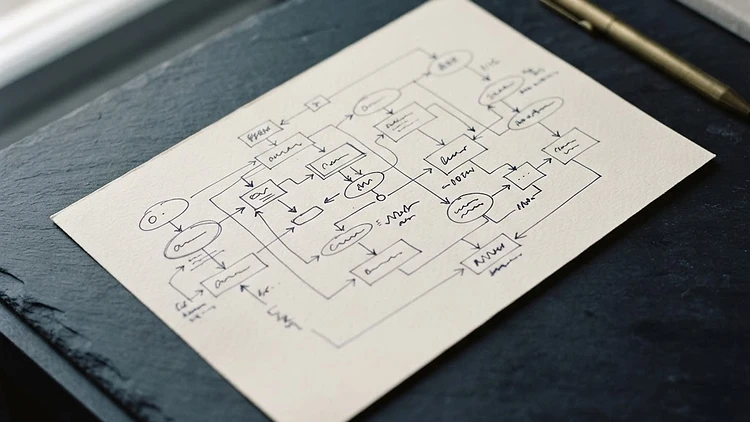
A great prompt is satisfying. You tune it, the output clicks, you save it somewhere, and you feel productive. For a few days it becomes your secret weapon.
Then a colleague needs to use it, and it does not work. Or you come back to it three weeks later for a slightly different case, and it produces something strangely off. The reason is simple: your prompt was never really instructions. It was a private conversation you happened to have written down, full of assumptions only you could see.
This is the moment most professionals stall. They have learned to get good results from AI, but those results stay locked inside their own habits. This article explains why prompts decay, what a process adds, and the three practical steps that turn your best AI work into something a team can rely on.
Prompts decay; processes compound
A prompt is optimized for one moment: this task, this context, this week. It leans on everything you knew when you wrote it, including the background you had in mind, the example you had just looked at, and the corrections you made in the next three messages without noticing.
A process is optimized for repetition: the same kind of work, arriving again and again, with small variations. It assumes nothing. It carries its own context. It tells whoever runs it, human or machine, what to do, what to avoid, and how to know when the job is done.
The practical difference shows up over time. A prompt gets slightly worse every time the situation drifts from the one you wrote it for. A process gets slightly better every time you run it, because each failure tells you exactly which rule or piece of knowledge to add. One decays. The other compounds.
Why your best prompt fails in someone else's hands
When a colleague runs your prompt and gets a weak result, it is tempting to blame the colleague or the model. Usually neither is at fault. The failure comes from one of three hidden gaps.
Hidden taste. Your prompt says "write a short summary," but you know that "short" means under 150 words, that leadership dislikes bullet points, and that the conclusion always comes first. None of that is written down.
Hidden knowledge. Your prompt refers to "our standard pricing tiers" or "the usual risks." You know what those are. The model does not, and neither does your colleague, so both improvise.
Hidden judgment. After the first draft, you always fix the same two things by hand. That correction step is part of your real method, but it never made it into the prompt. When someone else runs it, the correction never happens.
A process is simply what you get when you make all three visible.
The three steps from prompt to process
The move from prompt to process has three steps, and none of them require code.
1. Extract the judgment
Take your best prompt and annotate it line by line. For each instruction, ask which kind it is:
- Taste, such as "keep it formal" or "lead with the recommendation."
- Rules, such as "never invent numbers" or "always name an owner for each action."
- Context that changes every time, such as the client name, the date, or this week's data.
Taste and rules belong in the process, written so explicitly that a stranger would apply them the same way you do. Changing context belongs in the input, the part that gets swapped each time the process runs. Then add the corrections you usually make by hand. If you always remove filler phrases, that becomes a rule. If you always check figures against the source, that becomes part of the check.
2. Separate the knowledge
Anything the prompt assumes you already know, such as definitions, examples, standards, product details, or tone guides, moves into a reference the process can always reach. This might be a short document of internal terms, two or three examples of excellent past output, or a list of facts that are always true in your business.
This is the step most people skip, and it is the one that makes a process portable. Instructions tell the system what to do. Knowledge lets it do that work the way your organization does it. Without the reference, every new user has to supply the missing context from memory, and the results drift.
A useful side effect: once knowledge lives in its own document, you can update it once and every process that uses it improves at the same time.
3. Define the handoff
Write down three things: what the process receives, what it produces, and how a person checks the result.
The input description should be concrete enough that someone knows exactly what to paste in. The output description should specify format, length, and structure. The check should be short and specific, a handful of questions a reviewer can answer in a couple of minutes, such as "does every figure appear in the source?" or "is there a clear recommendation in the first paragraph?"
A process without a check is a liability. The check is what makes it trustworthy enough to share, and it is what lets a new user run the process confidently instead of anxiously rereading everything.
A small example
Consider a consultant who uses AI to turn interview notes into insight summaries. Her original prompt was one sentence. Her process, by contrast, fits on a page and a half: an input description (raw notes from a single stakeholder interview), a reference (the project's key questions, a glossary of client terms, and one excellent past summary), instructions (group findings under the project questions, quote the stakeholder only when the wording matters, flag contradictions with previous interviews, never draw conclusions the notes do not support), and a check (every finding traces to the notes, every project question is addressed or marked as not covered).
Her junior colleagues now produce summaries that need light edits instead of full rewrites. The prompt took her ten minutes to write. The process took an afternoon. The afternoon paid for itself within two weeks.
The one-sentence test
Here is the whole difference in one sentence: a prompt is something you use, a process is something you can hand over.
If your best piece of AI work lives in a note only you can run, it is a prompt. The moment a colleague can take it, run it on their own work, and get the same standard of result, it is a process.
That handover moment is worth more than any single prompt you will ever write. It is also the exact skill that separates people who use AI from people who build with it, and it is a skill that keeps its value no matter which AI tools win the next round.
Build this skill with Praxaria AI
Making your best AI work repeatable is the core habit of every builder. That is exactly what The AI Builder Program by Praxaria AI is designed to teach. It is a self-paced, 14-stage path, including a Capstone, that takes non-coding professionals from understanding AI to specifying, building, testing, and handing over working AI systems on their own real work, guided by worked examples at every stage.
If you are ready to move from using AI to building with it, explore The AI Builder Program at praxaria.com.